
You are not still thinking about what happened. You are still standing inside it. On a Sunday afternoon you park at the end of the street where you grew up, and you do not get out of the car right away. Eleven steps from the car door to the front step. You know the number because you counted it once, years ago, while waiting for a reason to walk faster.
Your mother opens the door before you reach it and says, oh, you came. Two words of welcome, and a small drop in the voice at the end that nobody else on earth would hear. You are forty one years old. You pay a mortgage, you manage people, you are trusted with things that matter. For the length of that sentence you are nine, and the hallway smells the way it smelled then, and some part of you has already begun apologizing for something that has not been named.
Nothing happened. That is the part you can never explain to anyone.
Later you replay the afternoon in the car and find nothing to point at. No insult. No accusation. A door, a greeting, a slight change in pitch. And yet for eleven steps you were not an adult visiting his parents. You were a child arriving at a verdict that had already been decided somewhere out of sight.
People call this holding on. The phrase is too light. It suggests a hand that could open if you decided to open it, and a person too stubborn or too injured to decide. What is actually operating is closer to an address. You moved out. Something in you never filed the change, and the mail still arrives.
There is also a word people reach for when someone stays near an old injury for many years. That word will not be used here. Not because it is never accurate, but because it names a temperament, and what you are living inside is not a temperament. A temperament is something you are. A room is something you are standing in.
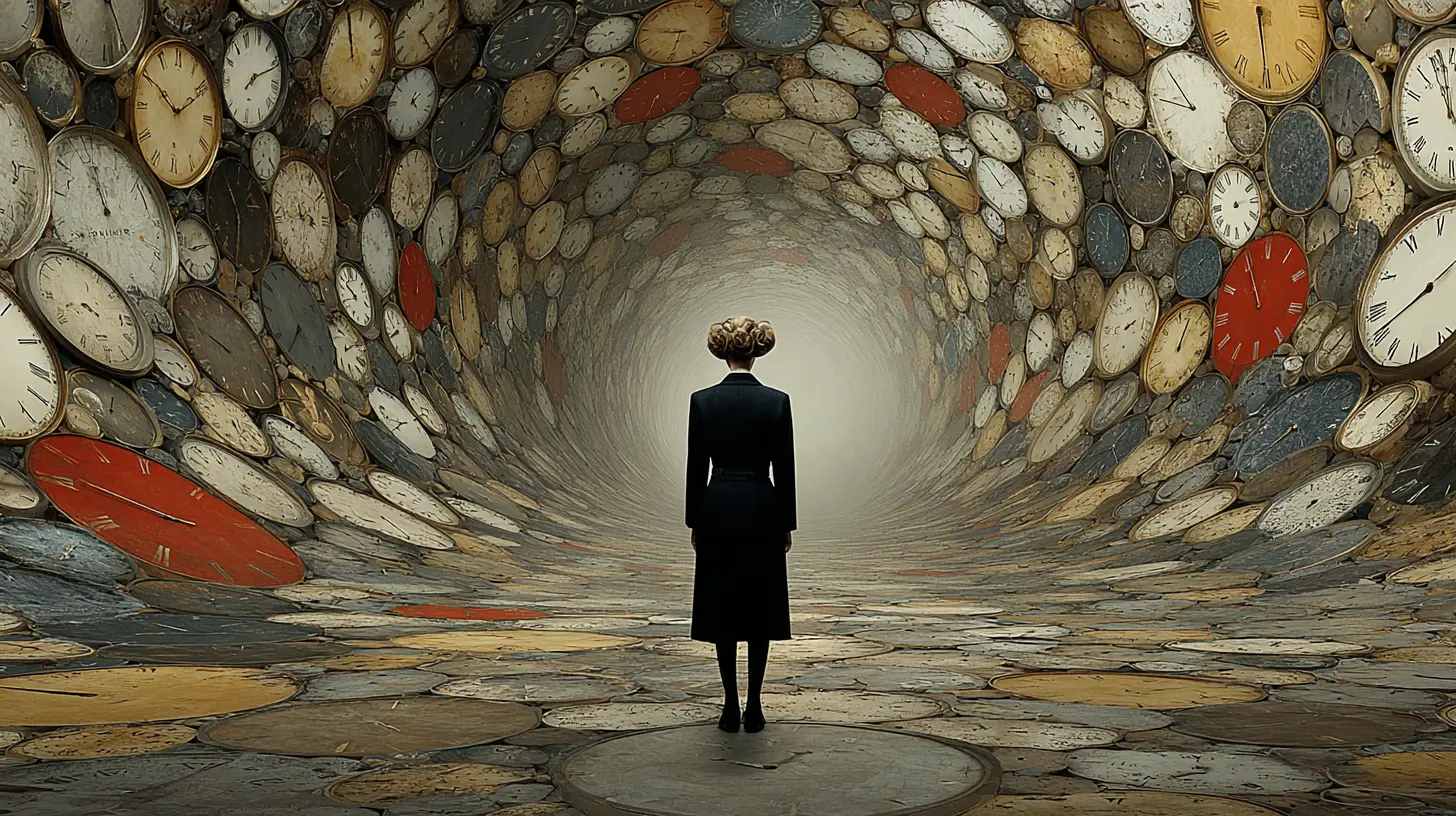
The clock in your life moved. The clock in that room did not.
Thirty years can pass on a calendar without a single year passing inside a person. The unconscious does not measure time the way a calendar measures it. It measures transformation. Where an experience has been endured but never assimilated, no psychological time has passed at all. The event is not behind you. It is beside you, still open, still waiting for the conditions that would let it finish.
Jung gave this a name. He called it a complex, and he was careful to insist that a complex is not the same thing as a painful memory. A memory is something you hold. A complex is something that holds you. It has its own atmosphere, its own reading of a room, its own reserve of energy, and its own intention. When it is activated it does not add a feeling to the present. It replaces the present.
The ego believes it is the master of the house. Then the complex enters, takes the chair, changes the light, and begins speaking through your mouth. Afterwards you stand in your own kitchen and ask why you said that, why you went quiet, why you agreed to a weekend you did not want. You look for the reason inside the conversation. It was never inside the conversation.
A personality is not one indivisible thing. It is closer to a house built above older chambers. The upper rooms are lit and modern and full of your opinions about yourself. Below them are cellars nobody has opened in two generations. You live upstairs. You tell visitors the basement is nothing. And at certain hours you hear movement under the floor.
And the record of all this is not kept in the mind. It is kept lower down. Long after the content of an event has become vague, the body continues to hold the posture that the event required. The shoulders of someone who learned to expect criticism. The shallow breathing of someone who learned that raised voices preceded something worse. You cannot recall the specific afternoon. Your spine can.
The person who stays in the past is very often the person who has worked hardest to leave it. You were told to forgive. You were told to move forward, to think positively, to be grateful, to stop making an old injury into an identity. You may have obeyed every instruction you were given. You may have built a persona of remarkable steadiness, and other people may lean on it.
The better the performance became, the deeper the unlived part went.
Nothing leaves the psyche because it was dismissed. What consciousness refuses does not stop existing. It becomes invisible, and invisibility is not weakness. Invisibility is freedom of movement. A part of you that cannot be seen is a part that cannot be questioned, and it will use your voice, your calendar, and your choice of partner to finish saying what it was never permitted to say.
Consider what happens to a child in a house where one particular feeling is not allowed. Not forbidden by any rule. Forbidden by atmosphere. The child learns precisely which expressions cause the temperature of the room to drop, and stops producing them, and grows into an adult who believes that this was character rather than adaptation.
A quality that has been exiled does not die. It waits.
And what waits in the dark tends to come back wearing somebody else's face. The partner who is described as demanding. The colleague who is described as too emotional. The sister who always wants more than is reasonable. Some of this is accurate. Some of it is a parcel returned to you with your own handwriting on the label, and you cannot recognize the handwriting because you were nine years old when you wrote it.
What makes this difficult to catch is that the returning material never announces itself as old. It arrives dressed for the current decade. It has opinions about your marriage, about your work, about the friend who took four days to reply. Everything it says sounds like a conclusion you reached this morning, in your own voice, using evidence available in the present tense.
It is a Thursday evening at the corner cafe, the second table from the window, the one with the leg that rocks whenever anyone leans on it. A friend is describing a difficulty with her father, and she stops in the middle of a sentence and says, sorry, this is probably a lot. You hear yourself answer, it is fine, tell me everything. Your coffee has gone cold because for twenty minutes one hand has been holding the table steady.
Nothing in that evening belongs to your childhood. The friend is not your mother. The cafe did not exist when you were nine. And yet the arrangement is identical. Someone's discomfort appears in the room, and your first movement is to become smaller and steadier so that the room does not tilt.
The table rocked the entire evening. You never once asked to move.
This is what it means to say that the past is not a period of time. It is an arrangement. And arrangements travel. They fit into new rooms, new decades, new cities, new people who have never harmed you, and they operate there with exactly the authority they were given when they were installed.
So here is the first honest answer to why some people never leave, and it is not the answer that gets repeated. They do not stay because they are weak. They do not stay because they secretly enjoy the suffering. They do not stay because they have failed to try hard enough. They stay because something inside them is still keeping an appointment.
An appointment made a long time ago, with someone who is not coming.
The injury is not what holds a person in place. The loyalty is. To stop waiting would mean accepting that no one is going to arrive and explain, that the apology will not be delivered in the form you needed, that the person who owed you an account of what happened may have died without ever knowing there was a debt. Waiting keeps the possibility open. Grief closes it.
And between an open impossibility and a closed truth, the psyche will very often choose the impossibility, because an impossibility still contains a future and a truth of that kind contains only an ending. This is not a failure of intelligence. Intelligence is not what is deciding. The part of you that keeps the appointment does not know that the person has died, or moved, or forgotten, because the news never reached the room where it is waiting.
This is why advice fails so reliably here. Advice speaks to the part of you that is sitting in the car at forty one, and that part already agrees. It agrees completely. It has read the books, listened to the talks, explained the same insight to a friend with real clarity, and meant every word of it. That part of you needs no persuading and never did.
The part that will not move was never listening, because it does not believe the conversation concerns it, because in its own reckoning the matter has not been settled yet and therefore cannot be past. You cannot talk somebody out of a room they are still standing in. You can only make the room visible.
And there is a further complication, which is that this arrangement has been useful. The vigilance made you observant. The smallness made you easy to be around. The steadiness made you the one who gets called when something has gone wrong at midnight. You were rewarded for the adaptation. Nobody rewards you for setting it down.
So the question is not why you have not let go. That question has been asked of you for years and it has never once produced a change, because it assumes there is a hand and a decision. The better question is what would have to become true before letting go stopped feeling like an abandonment. Not of the person who hurt you. Of the child who is still in the room, still waiting, still holding the position you assigned.
Now something you can actually observe this week, because everything said so far could be claimed about anyone.
Watch the order of events. In an ordinary present tense reaction, something happens and then the feeling arrives. Someone says a sharp thing, and afterwards the heat comes up in you. When the past is running the room, that order reverses. The feeling is already in position before the sentence has finished. The body has answered a question that has not been asked yet.
The reaction arrives early because it is not a reaction. It is a return.
You can measure this in your own week. Eleven steps from the car to the front step, and the tightening begins somewhere around step three, long before anyone has opened a door or said a word. Not after the greeting. Before it. Whatever produced that response is not inside the house. It travelled there with you, in the passenger seat, the whole way.
And once you have seen the order of events, a much harder question opens. Because a feeling that arrives early is not lying to you. It is reporting accurately. It is simply reporting on a room you stopped standing in three decades ago, in a voice you have not heard since, and about that room it has never once been wrong. So the feeling is accurate. That is the complication, and it is the reason the test you were just given cannot be used the way you want to use it. The early feeling is not a malfunction. It is a report, and the report is precise. What it fails to tell you is the date.
Sometimes the present really is repeating the past. A person who was controlled as a child does occasionally end up beside a controlling partner. A person who was criticized without mercy does sometimes find the one colleague in the building who criticizes without mercy. The unconscious is not always wrong about the room it is in. So you cannot simply decide that every strong feeling is an old one and dismiss it. That would only be a more sophisticated way of not being present.
The work is harder than deciding. It is distinguishing.
You can watch the difference in your own body on those eleven steps. Some Sundays the tightening that begins at step three eases by the time your mother has said hello and the afternoon turns out ordinary. The feeling negotiated. It met the present, found it bearable, and let go.
That is a present feeling doing what present feelings do. Other Sundays nothing she does can touch it. She is warm, the visit is fine, and the tightness stays exactly where it was at step three, sealed off from everything actually happening, because it was never about this visit. It was about a visit thirty years ago that this one merely resembles.
Between a feeling that belongs to now and a feeling that arrived early there is a difference you can learn to notice, and it is not the intensity but the shape. A present feeling can change when the situation changes. You say the difficult thing, the other person responds well, and the feeling loosens in real time.
An old feeling cannot be moved by anything happening in the present, because the present is not what it is responding to. You could receive the exact reassurance you wanted, and it would not land, because the person it needed to come from is not in the room, and no substitute has ever been accepted.
That is how you tell them apart. A present feeling negotiates. An old one only waits.
Consider what this looks like inside an ordinary week. Your sibling calls. Not often. There is one week each year when the phone rings, the same week every time, and everyone in the family knows which week it is and nobody says the name of it out loud. The call is brief. Afterwards you sit with the phone in your hand for a while longer than the call itself lasted, and something in your chest has the texture of being eight years old.
Nothing was said on that call that a stranger would find remarkable. And yet you carry it for the rest of the afternoon. The date the feeling is reporting on is not today's date. It is a date from a house you both left decades ago, and the two of you meet there, briefly, once a year, and then hang up.
This is the mechanism Jung was pointing at when he described the way the psyche keeps what consciousness will not hold. A grief that is never consciously mourned does not evaporate. It goes underground and continues its work in the dark, and it will use whatever material the present offers. A phone call. A tone of voice. One week on a calendar that the whole family has agreed to walk around.
What is buried does not rest. It waits for a door, and the present is generous with doors, offering a new one every time a voice drops at the end of a sentence or a familiar week comes around on the calendar.
There is a dream that arrives often to people living in this condition, and it arrives in many forms but with one recurring shape. The dreamer is walking through a house, an ordinary house, and discovers a room that should not be there. A door that was always assumed to be a closet opens onto a stairway going down.
At the bottom, in a small locked chamber, there is a child. The dreamer knows, in the way one knows things in dreams, that the child has been down there the entire time. That the child was left there. That no one came. In the dream the dreamer calls out, and the child does not answer. Sometimes the child only looks up. Sometimes the child does not even do that. The dreamer wakes with the certainty that something has been abandoned, and cannot immediately say what.
Someone was left downstairs. The dream is only asking you to notice.
The unconscious is not being cruel when it produces this dream. It is doing the one thing available to it. It cannot speak in sentences, so it builds an image, and it hands you the image night after night until you are willing to look at what it is showing you. The child in the cellar is not a metaphor you need to decode into a lesson. It is a part of you that stopped, at a particular age, and has been waiting at that age ever since.
The past held that child not because too much was remembered, but because too little was ever allowed to be felt.
Here is where people go wrong in a way that feels like wisdom. They decide the answer is to stop feeling anything about it, to rise above it, to become the kind of person for whom the old injury no longer registers. This is presented everywhere as maturity. It is not. It is a second exile, performed on the same child, by the adult this time instead of the parent.
The child in the cellar does not need a wiser jailer, and it does not need the door painted a calmer color. It needs someone to come down the stairs, which is the one thing every strategy of rising above is designed to avoid.
And the feeling you are trying to eliminate is the only thing that knows where the stairs are. Suppress it, and you have not resolved anything. You have only moved the door, so that now even you cannot find it, because that feeling is carrying information, and information does not stop being true because it has become inconvenient to hold.
Take anger, since anger is the feeling most often condemned in people who were hurt early. You may have been taught, without a single word being spoken, that your anger was the most unacceptable thing about you. So you removed it. You became agreeable, understanding, endlessly able to see the other side, and you may believe to this day that this was simply your nature rather than a removal you performed on yourself.
But there is a distinction here that changes everything, and it has to be held carefully rather than collapsed. There is an anger that protects a life, and there is an anger that imprisons one, and they are not the same thing wearing different intensities. They are different in their direction.
The anger that protects says, this must not happen again. It draws a line in the present and defends it. It is finished once the line is drawn.
The anger that imprisons says something else entirely. It says, I cannot begin to live until the past admits what it did. It does not draw a line. It files an appeal, again, in a court that adjourned decades ago and is never going to reconvene. The first kind builds a boundary. The second kind builds a cell and calls it justice.
Most people who were hurt as children were denied the first kind of anger and are secretly consumed by the second. They were not allowed to say this must not happen again when it mattered, so the anger had nowhere to go.
It turned inward instead, and became a permanent grievance against a world that will not apologize. And a grievance, unlike a boundary, cannot be satisfied, because its condition for satisfaction is that the past become different than it was.
You can feel the difference in how each one ends, if you watch for it. A boundary, once set, quiets. You said the thing that needed saying, the line now exists in the world, and the body registers that the work is done and stands down. There is a particular relief in it, the relief of a sentence that has finally been spoken aloud after years of being rehearsed.
A grievance never stands down. It reopens the same file every time it is fed a new example, and the world is generous with new examples, and so the case grows thicker every year while never once approaching a verdict.
No verdict is coming. That is not the tragedy. That is the way out.
Yet the trap holds precisely because the way out looks like defeat. It is worth naming plainly because so many people spend a lifetime inside it without recognizing it as a trap at all. As long as your peace depends on someone else waking up, apologizing, understanding at last what they did, you have handed the key to a person who may never use it.
They may not even know they are holding it. And a key that its owner does not know exists is a key that is never going to be turned, which means the door it fits is not a door at all anymore. It is a wall you have chosen to keep calling a door, because a wall would mean the waiting was always going to be for nothing, and that is precisely the grief you have been avoiding.
A colleague who criticized you for years may retire without a single thought about you. He may not remember your name in a decade. He may have filed the whole period under nothing at all.
A parent who withheld may die believing they did well, and may be at peace, and may deserve that peace or not, and either way will not be filling out the apology you were saving a place for. Not one of them is coming down to sign for it. Your sibling on that annual call may never once name the week you both keep circling, and may not even know the two of you are circling it.
So your freedom cannot be kept in a place you have no way of reaching.
And if your freedom is stored inside their eventual recognition, then your freedom is stored somewhere you cannot reach, in a safe whose combination only they know, and they have gone home for the night, and the building is dark, and you are still standing in the lobby explaining to no one why you deserve to be let in.
The lobby is warm and well lit and completely empty, and it has been empty the whole time you have stood there. No one is coming to the front desk. No one is going to look up your name and confirm that yes, you were wronged, and yes, the record shows it, and yes, you may go. You could turn and walk out at any moment, and the only thing holding you is the belief that leaving without that confirmation means it never happened.
This is one of the harder truths that arrives when a person becomes conscious. You discover that the recovery you were waiting for was designed to be delivered by someone who is not coming. And for a while this feels like the loss of hope itself. It is not. It is the loss of one particular hope, the hope that the original wound will be healed at its source, by the source. That hope has to be grieved before anything can take its place.
You cannot think your way out of it. It can only be mourned.
But the moment that hope is set down, something the ego did not expect becomes possible. The recovery stops being something owed to you by another person, and starts being something you are permitted to build yourself, out of the same materials, in the present tense, without their signature on it.
The appointment does not have to be kept for you to finally leave the waiting room. To build something yourself, in the present tense, you first have to be able to tell the present from the past while you are standing inside a feeling. This is the skill everything else depends on, and it is not an insight. It is a practice, performed in real time, usually badly at first.
It begins with a single question asked in the middle of the emotional weather, not afterward in the calm. The question is this. How old do I feel right now. Not how old am I. How old do I feel. And the honest answer, when a complex is running the room, is almost never your actual age.
You are forty one and you feel nine, and the whole difficulty of your life lives in the distance between those two numbers. The forty one year old pays the mortgage and runs the meeting and is trusted with things that matter. The nine year old decides, without consulting anyone, how the room actually feels and what is required to keep it safe. And for most of your life the nine year old has been winning quietly, from behind, without ever being seen to enter.
The gap between those two numbers is the entire problem, and it is also, for the first time, something you can see. Naming it does not dissolve it. But it does something almost as useful. It puts a small distance between you and the feeling, a distance just wide enough to stand in, and inside that distance the feeling stops being the whole of reality and becomes something you are having rather than something you are.
You can test the practice on those steps, because they are countable and the feeling that runs them is not. The next time you park at the end of that street, try asking the question on the walk in. Step three, where the tightening starts. How old do I feel right now. If the answer that comes back is nine, then you have caught the complex in the act, before it reaches the door, before it takes the chair.
You will still feel it. But you will feel it as a nine year old's feeling arriving in a forty one year old's body, which is a very different thing from simply becoming nine again without knowing it happened.
The eleven steps do not get shorter. What changes is who is counting them.
Return to the corner cafe. The second table from the window, the one with the leg that rocks when anyone leans on it. It is a different evening, months after the first. The same friend is telling you about the same kind of difficulty, and the familiar movement begins, the old reflex to become smaller and steadier so the room does not tilt.
This time you notice your hand is already on the table, holding it still.
And this time, having noticed, you take it off. You let the table rock. You keep listening, and the rocking does not swallow the conversation, and your friend does not leave, and the sky does not fall. You have done nothing dramatic. You have simply declined, for one evening, to be the one who holds everything level. The table wobbles under her elbow and she does not even notice, and the two of you go on talking.
Something in you is appalled at how small the gesture was and how much it cost, and that disproportion is the whole tell. A gesture that trivial should not require that much nerve. The size of the fear is a measurement of how old the rule is, and how early it was installed, and how faithfully you have kept it since.
That cost is the thing no one warns you about, and it has to be said plainly here, without softening, because the softening is what makes people give up. When you stop performing the old adaptation, you do not feel free. Not at first. At first you feel exposed, and useless, and vaguely guilty, as though you have abandoned a post you were assigned before you could speak.
There is a cold stretch between putting down the old arrangement and finding anything to put in its place. In that stretch you have lost the identity that organized your whole life and gained nothing yet to replace it.
The people who relied on the old you may not enjoy the new one. Some of them will drift. Some will tell you that you have changed, and they will not mean it as a compliment. And the confirmation you keep waiting for, the sign that you did the right thing, does not arrive on any schedule you can predict, and sometimes does not arrive at all.
You will look for evidence that you did the right thing, and the evidence will be ambiguous for a long time. The friend does not thank you for letting the table rock, because she never noticed you were holding it. The family does not congratulate you for declining a role they needed you to keep playing. The reward for stopping is mostly the absence of a familiar exhaustion, and an absence is a difficult thing to feel grateful for, especially in the beginning, when it mostly reads as emptiness.
No one hands you a receipt for the decision to stop disappearing.
It takes longer than anyone tells you. The books make it sound like a threshold you cross once. It is not. It is a room you have to walk out of many times, because you keep waking up back inside it, and each time the walk out is a little shorter, and for a long while that is the only progress there is.
This is the honest price, and it does not come with a guarantee attached, and anyone who tells you otherwise is selling the version that does not work.
What makes the price payable at all is that the alternative has a price too, and it is higher, it is just spread out so thin across so many years that you stopped noticing you were paying it. The exhaustion of holding every table level. The slow narrowing of a life arranged around not disturbing anyone. The relationships in which you were present but never quite arrived. That bill has been debited quietly your whole life. The cold stretch, at least, ends.
Now, having said that plainly, we can say the other true thing, which is that the price buys something real. What it buys is the end of an inheritance you did not know you were carrying.
Because the appointment you have been keeping was often not even scheduled by you. Families do not pass down only names and furniture and the shape of a nose. They pass down instructions, most of them never spoken aloud. Do not outgrow us. Do not be happier than the ones who came before you. Do not name the thing we agreed never to name. A child absorbs these long before he has words, and carries them for decades believing they are his own personality.
The unlived life of a parent does not disappear because the parent grew old. It looks for somewhere to continue.
Consider your sibling again, and that one week each year when the phone rings. You have always assumed the strangeness of that week was a private thing between the two of you. But listen to what the call actually circles. It circles a silence that is older than either of you, a thing that happened or failed to happen a generation up, that no one has ever described directly, that has simply been handed down the way a debt is handed down, to whoever is still in the room when the bill comes.
The two of you are not keeping the appointment for yourselves. You are keeping it on behalf of someone who could not.
This is why the same wound can appear in a family across three generations wearing three different faces. A grandmother who could not grieve produces a mother who cannot rest, and the mother who cannot rest produces a child who cannot stop apologizing, and none of the three ever meets the original loss that set the whole sequence moving.
Each one believes the trouble is personal, a flaw in their own character, when it is closer to a package being forwarded, unopened, from an address that no longer exists, to whoever forgot to refuse delivery.
And here the work turns, because refusing delivery requires a feeling you were specifically forbidden to have. You cannot decline an inheritance politely. You have to feel the thing the inheritance was designed to keep you from feeling, and the family arranged your whole emotional education precisely so that you would not.
For most people it is anger, and we have already looked at that. But for many others the forbidden feeling is not anger at all. It is grief. Somewhere it was decided, without words, that this family does not mourn out loud, that sorrow is self indulgence, that the strong ones simply carry on. And so the grief went underground, and did what buried things do.
What the unconscious cannot say in the daylight it says at night, in images, to whoever is still willing to dream.
This is the point where the shadow returns what was exiled, and it rarely returns it gently. The quality you were forbidden, the anger or the grief or the ordinary human need, comes back with interest, often at the least convenient moment, often disguised as a symptom you cannot explain. The sudden tears at a stranger's small kindness. The disproportionate rage at a minor obstruction. The exhaustion that no amount of rest resolves.
You know these arrivals. You have apologized for most of them. These are not malfunctions. They are the exiled part, knocking. And it knocks harder the longer it was kept out, which is why people who held the line most perfectly for the longest time often come apart the most suddenly, in midlife, over something that looks from the outside like nothing at all. The strength was never strength. It was a door held shut against a room that kept filling.
And the temptation, the very old temptation, is to exile it a second time. To apologize for the tears, to swallow the rage, to push through the exhaustion. To do to yourself, once more, exactly what was done to you.
The whole task can be stated in one sentence. Stop being the parent who sent the child downstairs.
Which is harder than it sounds, because being that parent is the only competence you were ever fully rewarded for. You were praised for the swallowing. You were relied upon for the carrying. The room ran smoothly because you kept it level, and everyone thanked you for it, and no one ever asked what it cost the small person doing the holding.
So when you take your hand off the table and let it rock, you are not just risking one evening's discomfort. You are breaking a contract that several generations signed before you were born, and a part of you experiences that as betrayal even though the only person you are betraying is the one who taught you to disappear.
The rocking table is a very small crime against a very old law. A very old law, but not an unbreakable one. And once it begins to break, the first thing that arrives is not relief, which is what everyone expects and what almost no one gets. The first thing that arrives is guilt, and because it arrives exactly where you were hoping to feel free, it is easy to mistake it for proof that you made a mistake.
This surprises almost everyone. You expected that stepping out of the old role would feel like freedom, and instead it feels like you have done something wrong. You say the honest thing at last, or you decline the impossible favor, or you simply let a table rock, and some part of you braces for punishment as though you were still small and the room still belonged to someone whose mood decided the weather.
The guilt is not evidence that you have erred. It is the old law, still on the books, issuing its summons out of habit.
Because a rule that was installed before you had language does not update itself when you grow up. It keeps running in the background, and every time you act against it, it produces the same signal it produced when you were nine. The signal says you have endangered your belonging. It is loud, and it is convincing, and it is reporting on a danger that ended decades ago.
You can watch this happen in something as small as a declined phone call. Someone asks you for a favor you genuinely cannot give, a Tuesday evening you do not have, and you say no, plainly, without the paragraph of apology you would once have attached. And within the hour a low unease starts up, a sense that you have been unkind, that you should call back and offer something.
Nothing unkind occurred. You stated a limit, which is a thing an adult is allowed to do. But the signal fires anyway, on schedule, indifferent to the facts, because the rule it defends was written long before you were ever allowed to have a limit, in a house where your needs were the disturbance and everyone else's were the weather.
Guilt, here, is a memory pretending to be a conscience.
The work is to let the guilt be present without obeying it. Not to argue with it, which never works, and not to be ruled by it, which returns you to the cell. Simply to let it sit in the room, the way you might let an old relative complain from the corner, while you go on doing the thing it disapproves of. The guilt does not have to leave. It only has to stop being in charge.
And slowly, in a way you cannot force, the signal begins to lose its authority. Not because you defeated it, but because you stopped feeding it obedience. A rule enforced only by a feeling, and no longer by your compliance, is a rule quietly going out of print. It still prints the occasional summons. Fewer people report to it each year.
So freedom does not arrive as a feeling. It arrives as a slow change in who you obey.
There is a further trap waiting even here, at the very edge of freedom, and it is worth naming because so many people fall into it after doing all the hard work. Having put down the old adaptation, having stopped disappearing, a person will sometimes decide that the whole past should now simply be dismissed, that the parents were wrong and that is the end of it, that the only mature response is a clean and final judgment.
There is a word that has been waiting through this entire descent, deliberately held back until now. The word is bitter. It is the word the world reaches for when someone stays angry too long at what was done to them, and it is used as a verdict, a way of closing the case by faulting the person still carrying the injury.
It was held back because it is almost always aimed at the wrong target. Bitterness is not the same as remembering clearly. It is not bitter to know exactly what happened and to refuse to pretend otherwise. What earns the word, if anything does, is not the accuracy of the memory but the permanence of the demand, the insistence that the past keep paying, forever, in a currency it cannot produce.
Think about what the accusation actually asks of a person. It asks them to stop mentioning the injury, to speak of it in the past tense, to arrange their face into something untroubled, so that everyone around them can be comfortable. It punishes the symptom and protects the silence that caused it. The one still carrying the wound is told that the carrying is the problem, as though the weight had appeared from nowhere and had nothing to do with the people who set it down on them.
And that permanence, the thing the word is really pointing at, dissolves the moment you stop needing the past to be different than it was.
This is the quiet distinction almost no one is taught. You can hold the full truth of what happened, in all its weight, and still not be bitter, provided you are no longer waiting for the wound to be undone at its source. Bitterness lives in the waiting, not in the memory. When the waiting ends, the memory remains, but it stops being a grievance and becomes something closer to history. Yours, accurate, heavy in places, and finally finished.
And this is the difference that changes what the rest of your life feels like. History you can carry. History has weight, but weight can be carried, set down, picked up again, looked at in good light. A grievance cannot be carried, only served, and it demands service every day, and it never once reduces the sentence. The person who converts the grievance back into history is not letting anyone off. They are simply refusing to spend the only life they have in a waiting room.
You can love people accurately, which means without editing them into who you needed them to be.
Consider your sibling one last time. That one week each year, the phone, the silence that is older than either of you. Something has changed in how you meet it now. You still take the call. You still feel the pull of the old room. But this year, when you hang up, you do not sit for an hour with the phone in your hand.
You notice the pull, you recognize whose it is and how old it is, and you set it down, and you go and do the next ordinary thing in your actual life. The appointment still exists. You simply no longer live inside its waiting room the rest of the year.
You have stopped keeping the vigil on behalf of the dead.
And the strange grace of it is that this makes you gentler toward the very people you have stopped waiting on, not harder. When you no longer need your parents to have been different, you can finally see them as they were.
Small and frightened and handing down what had been handed to them, doing the arithmetic of their own unlived lives on your childhood because no one had ever taught them another way. That is not forgiveness in the greeting card sense, the kind that requires you to decide the harm was smaller than it was.
It is something more durable, because it does not depend on shrinking the truth. You can see the whole of what they failed to give and also see why they could not give it, and hold both at once, without either one cancelling the other.
The harm stays real. The understanding does not erase it. They simply exist together, the way most true things about people do. That is accuracy without a demand attached, and it turns out to be more freeing than any verdict, because a verdict keeps you in the courtroom and accuracy lets you leave.
Return one final time to the corner cafe. The second table from the window, the leg that rocks when anyone leans on it. It is an ordinary evening now, no crisis, no confession, just two people and a wobbling table. Your friend leans on it and it tips, and you both feel it, and neither of you reaches to steady it.
She keeps talking. You keep listening. The table rocks the whole evening and holds no meaning at all, because you are no longer the one assigned to keep the world level, and a rocking table is permitted, at last, to be only a rocking table.
Nobody is holding it steady. Nothing falls.
This is what the end of the trap actually looks like, and it is much smaller and much quieter than anyone imagines. There is no dramatic scene, no final confrontation, no apology delivered at last by the person who owed it. There is only a gradual and almost unnoticed return of ordinary time.
A gentle day stops feeling suspicious. A calm week stops feeling like the pause before something. The body, which spent decades braced for a blow that already landed long ago, slowly discovers that the blow is not coming again, and lets its guard down one degree at a time.
You notice it in ordinary places. A held breath you did not know you were holding, released halfway through an unremarkable afternoon. A door closing somewhere in the house that does not make you flinch. The vigilance that once scanned every room for the first sign of trouble finding, for longer and longer stretches, nothing it needs to do, and quietly becoming something else, an attention you can now point wherever you choose.
The alarm was never you. It was only the oldest thing in the house.
You cannot promise yourself that grief will never return. You cannot guarantee that love will never disappoint you again, or that the years ahead will unfold without loss. What has changed is not the world's capacity to hurt you. The world can still do what it does, and people you love will still, sometimes, fail you, and loss is still coming for everyone eventually. What has changed is that you are no longer asking a closed room for permission to live in the open one.
The old house still stands where it always stood. The voices still occasionally echo. But the child who waited there is no longer waiting alone, because someone finally came down the stairs, and it was you.
And that is the whole of it. Not that you forget. Not that you become invulnerable. Not that the past is rewritten into something easier to carry. Only that the life which stopped moving inside you, at nine, in a particular room, begins at last to move again.
The child who was left downstairs does not stay a child forever once someone comes for him. He grows the rest of the way up, at speed, catching up on thirty missed years in a rush that can feel like grief and relief arriving in the same breath. And then, for the first time, all of you is the same age, standing in the same present, looking at the same door.
So you drive out to that street, and you park at the end of it, and for a moment you sit before getting out, the way you always have. Then you open the door and you count the walk in.
Eleven steps, and this time you arrive as yourself.